


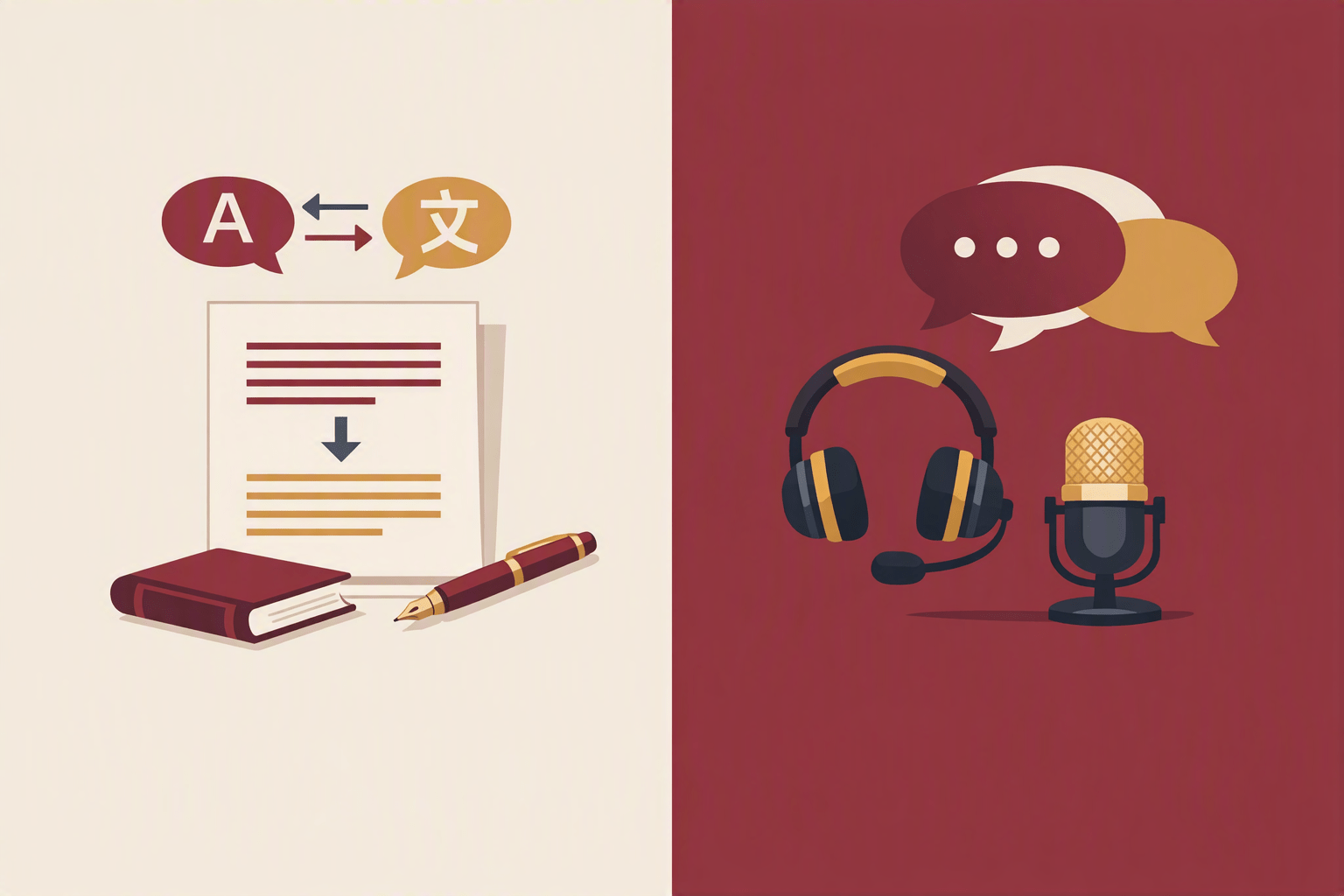
“I have a text that urgently needs interpreting.” Or: “Can your translator come along to a meeting tomorrow?” We hear questions like these more often than you might think. And to be fair, in everyday language, translation and interpreting are cheerfully mixed up all the time. Understandable? Absolutely. Accurate? Not quite.
Translators and interpreters both help people communicate across languages, but they do so in very different ways. One works with written texts, the other with spoken words. So let’s clear up the confusion once and for all.
Translation: from written text to written text
A translator works with written texts: contracts, websites, brochures, manuals, terms and conditions, medical reports, diplomas or sworn documents, to name just a few. They read the source text, understand exactly what it says, research the right terminology and rewrite the message in another language.
Sounds simple enough: swap a word here, adjust a sentence there, and you’re done? If only. Anyone who has ever read a poor machine translation of a legal clause, technical manual or marketing text knows that language is not a copy-and-paste job. A good translation requires linguistic skill, subject-matter knowledge, sensitivity to nuance and a clear understanding of the target audience.
A translator also has time to choose carefully. Does “claim” mean a compensation claim, a statement or an entitlement in this context? Should “policy” be translated as an insurance policy, a company policy or a set of rules? And does the text need a formal tone, or would a lighter, more fluent style work better? That is exactly where the craft lies.
Interpreting: from spoken language to spoken language
An interpreter works with spoken language. They render what someone says orally, often in real time. That may be during a meeting, training session, court hearing, company visit, press conference, medical consultation or international conference.
When interpreting, there is little or no time to look things up, weigh up three alternatives or elegantly rephrase a sentence. The interpreter has to listen, understand, remember, process and reproduce the message — accurately, completely and without losing the speaker, client or audience along the way.
Interpreting is therefore not simply “speaking a bit of French” or “having good English”. It is a profession in its own right. A good interpreter masters not only the languages, but also the techniques of listening, note-taking, summarising, anticipating and switching rapidly between cultures and contexts.
Consecutive, simultaneous or whispered interpreting?
There are several types of interpreting, each suited to a different setting. In consecutive interpreting, the speaker talks for a short stretch, after which the interpreter renders the message in the other language. This format is often used for smaller meetings, training sessions or official conversations.
In simultaneous interpreting, the interpreter renders the message almost at the same time as the speaker. This requires intense concentration and is usually supported by equipment such as an interpreting booth, microphone and headset. Think conferences, international meetings or large-scale events.
Whispered interpreting, or chuchotage, is a form of simultaneous interpreting for one person or a small group. The interpreter sits or stands close to the listener and quietly interprets what is being said. Useful in some situations, yes — but not always the ideal solution for longer or more complex assignments.
A translator is not automatically an interpreter
And the reverse is just as true. Some language professionals do both, of course. But translation and interpreting require different skills. A strong translator may feel perfectly at home with a complex text, a terminology list and a quiet workspace. An interpreter, on the other hand, works in the moment, where body language, intonation and timing can be just as important as the words themselves.
You could compare it to writing and public speaking. Someone who writes beautifully is not necessarily a natural public speaker. And someone who speaks fluently does not automatically produce polished, error-free texts. One talent does not rule out the other — but the two do not automatically go hand in hand either.
When do you need a translator?
Have a written text that needs to work in another language? Then you need a translator. This applies to marketing copy, legal documents, technical manuals, websites, newsletters, presentations, reports and official paperwork.
Will the text be used officially before a court, municipal authority, embassy, notary or other public body? Then you may need a sworn translation. That is still translation work, but with an official status.
When do you need an interpreter?
Do you have a meeting, consultation, negotiation, training session, interview, court hearing or event where people need to understand each other as they speak? Then you need an interpreter. And when the subject matter is sensitive, technical, legal, medical or commercially important, it is best not to rely on “someone who speaks a bit of English”.
Because yes, good intentions are lovely. But in language, small nuances can have major consequences. A mistranslated word in a contract is annoying. A misinterpreted statement during a negotiation, medical consultation or court hearing can become downright problematic.
The right language professional for the right job
Translation and interpreting have the same goal: helping people understand one another. The difference lies in the medium: one is written, the other spoken. A translator makes sure your text reads clearly, accurately and naturally in another language. An interpreter makes sure your spoken message comes across clearly and without unnecessary confusion.
Not sure whether you need a translator or an interpreter? No problem. Tell us what kind of language support you need, which languages are involved and what the context is. We will be happy to help you choose the right solution for your assignment.