


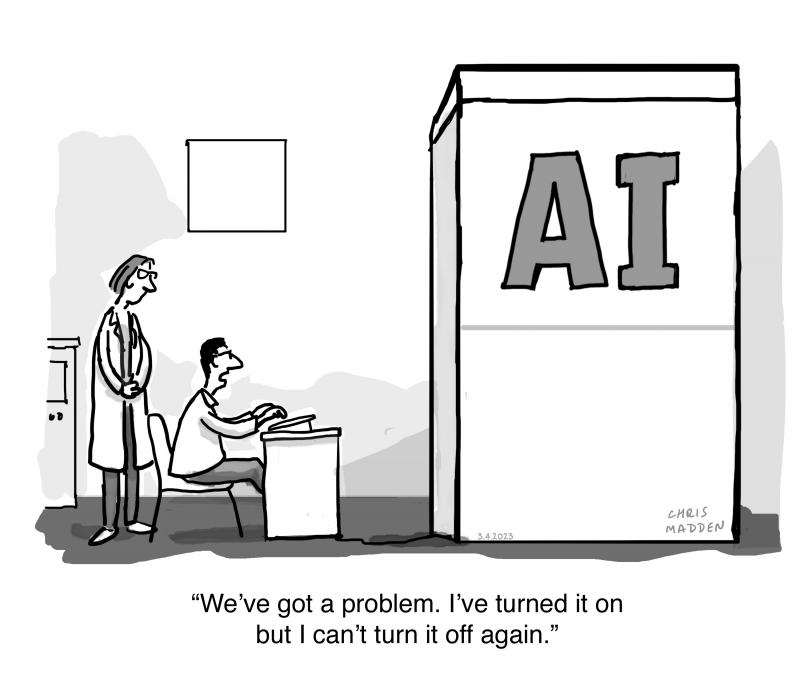
Let’s talk about the elephant in the room: AI. Or AI, AI, AI, as my son always says.
In the world of translation, artificial intelligence has triggered nothing short of a revolution. But let’s not be dazzled by the shiny promise of technological progress, because beneath the surface lie some very real risks.
There is no escaping it anymore: if you are not using AI, you risk being left behind. Keeping up has become part of the job. So, as translators, we sign up for webinars and training courses on how to weave this new technology into our daily work. And yes, its potential is huge. But so are its blind spots — and they deserve a closer look.
During the most recent webinar I attended, the trainer suggested that clients should sort their texts according to how much accuracy matters. Legal and medical texts, she said, are in a different league: mistakes in those fields can have serious consequences, so a specialist human translator remains essential. “Social media posts and customer communications,” she argued, “matter far less. You can simply run those through AI and publish them without human review.”
My ears pricked up when I heard that rather sweeping claim… and I was not the only one. Many professional translators found it a strange premise, and the chat quickly filled with reactions.
As professional translators, we are bridge builders. We aim for the highest quality in every translation and revision, whatever the type of text. We know that clear, accurate communication is the bedrock of every relationship.
A clear, accurate translation that respects cultural nuance and local sensitivities is vital to any form of written communication — and to genuine understanding between both sides.
Get the text wrong, or ignore the reader’s context and sensitivities, and you are quietly planting explosives under that relationship.
“It’s good enough,” people sometimes say. Good enough! Would you choose a doctor who is merely “good enough”? Or eat at a restaurant where the hygiene is “good enough” — would that still sound good enough to you? Or hire a contractor to build or renovate your home “well enough”? I don’t think so.
So why on earth would a company settle for texts that are merely “good enough” — and knowingly send out content containing errors and inaccuracies?
Companies spend millions on marketing. They go to great lengths to build a strong reputation. They pay consultants eye-watering fees. You never get a second chance to make a first impression, so everything has to be spot on.
And then they let AI loose on their communications, torpedoing that carefully built reputation with their own hands — and in record time?
In multilingual projects, things can go even further off the rails: the French version, for example, may end up saying something completely different from the Dutch or German one. Make of that what you will — it baffles me.

Every day, social media serves up fresh batches of hilarious translation blunders spotted in the wild. They just keep coming, as if companies learn nothing from their mistakes. Much of this communication is supposedly “fleeting”, so apparently accuracy no longer matters all that much. “Good enough” will do.
Do these organisations really think consumers are idiots? That this kind of communication does not register with people, consciously or otherwise? That only language purists notice? That no one reads a text full of ambiguity and inaccuracies as a reflection of the company’s quality standards — or even of the company itself?
And we have not even touched on the two other elephants AI brings into the room with it: confidentiality and liability.
Confidentiality, or the lack of it
Did you know that with almost any free AI platform, you are handing over all your data? If the service is free, you are the product: your data are shared and used to train AI. The information you upload does not simply travel one way. Many texts contain confidential information, such as names, amounts, identity details or medical data. All of that is fed into the system. In a sense, those data are shredded and absorbed into so-called LLMs, or Large Language Models. The odds of them resurfacing in exactly the same form are small, but you may still want to ask yourself whether you — or your client — would be comfortable with those data being used to train AI, taking on a life of their own, possibly forever, beyond your control and with no real visibility over what happens to them. That control is simply GONE.
What about liability?
Then there is the thorny issue of liability. Who is responsible if an AI translator makes a mistake with harmful consequences? The programmers? The users? The AI itself? This grey area of responsibility can lead to legal nightmares and unresolved disputes.
Take the manufacturer of an industrial machine, for example. What happens if they have the manual translated by, say, ChatGPT? They know perfectly well that this is technical documentation. A mistake in the manual, or even a clumsily worded instruction, can cause physical injury and financial damage — and can cost lives. To protect themselves, they then ask a human reviser to check the text, often at rates lower than the average hourly wage of a cleaner or refuse collector.
Unsurprisingly, very few qualified professional translators and revisers are willing to take on this kind of soul-destroying work. Sadly, there will always be people desperate enough to accept it. More often than not, they are precisely the less experienced or unqualified people who think: “How hard can it be?” Quite hard, actually. Trust me. A university Master’s degree in Applied Linguistics takes five years for a reason.
We once came across the following sentence in the source text of a technical manual:
“Do not forget to connect the device to the mains before carrying out any maintenance work.”
What if that underpaid reviser leaves the sentence untouched, and a tired maintenance worker on a bleak Monday morning follows the manual to the letter — and is fatally electrocuted?
In that scenario, legal action is all but inevitable, whether by the insurer, the bereaved family or the company where the machine was used. Who do you think will be called to account in court for that error in the manual? I fear the underpaid reviser will not stay out of the line of fire: a small fish with little or no legal backing, while OpenAI, the big fish with an army of lawyers, most likely will. It will then be for the judge to decide who is partly or fully liable — but one thing is certain: it will be anything but straightforward. A legal nightmare for the freelance translator involved.
So look before you leap, and think carefully in advance about the possible consequences. A relatively small saving can have very serious consequences, both human and financial.
Bias and political leanings
But the danger extends beyond legal and privacy issues. AI translations are susceptible to bias and political leanings, which can result in distorted and misleading translations.
In another webinar, the head of a major tech company made it clear that fully automated AI translation without human revision is nowhere near ready for prime time.
Language, it turns out, is far more complex than AI can currently handle.
AI does not yet grasp context and background knowledge nearly well enough — the very things we humans process almost instinctively. What is more, the LLMs mentioned above are trained on vast quantities of internet text. And the internet is hardly a model of objectivity, let alone political correctness. The result can be content that is biased on several fronts, and at times downright offensive to certain groups.
A few examples:
- doctors or bankers are assumed by default to be white men;
- cleaners are almost always women;
- a female IT Director is routinely portrayed as a white man;
- and so on.
All this at a time when we are finally making a serious effort to use inclusive and gender-neutral language.
On top of that, AI appears to have political leanings: its output often tends to be clearly right-leaning. Students who use ChatGPT to write papers or dissertations may also end up absorbing those positions uncritically. The potential impact on how we see the world — and on international relations — could be devastating. That hardly needs spelling out.
English versus other languages
One final interesting detail: 98% of the texts used to train these LLMs are in English. All other languages, including Dutch, account for just 2% of the training material.
The English-speaking world therefore embraced AI earlier and on a much larger scale. By 2022, people there were already experimenting with it at full speed.
And what happened? Two years later, many organisations that care about clear, accurate and error-free communication are turning back to human translators — despite the fact that AI has been trained on vastly more English material than content in other languages.
Conclusion
The rise of AI in translation is clearly a double-edged sword. It offers remarkable speed, reach and efficiency. But it also brings serious risks that should not be brushed aside. As users and developers of this technology, we need to make sure the benefits do not come at too high a price — and that we use AI with our eyes wide open.
So yes: vigilance matters. We need to think critically about AI’s role in translation before that elephant starts smashing the china.
Do you have a translation project in the pipeline?
Then be sure to contact Ad Verbum. Our human translators will be happy to craft a polished translation that does your message justice.
And don’t forget to explore our other language tips.